
Specific Administration Rules
Remember that testing must be conducted exactly as it is shown in the test booklet. If the student makes no response or does not appear to understand the test item, that item may be repeated only one time. Please be aware that there are a few items that may not be repeated at all. These items clearly say in the text of the examiner script that the examiner cannot repeat them.
If the student gives a partially correct answer or does not respond to the test item after it has been repeated once, you may follow up with the indented, italicized supplementary question or statement if one is provided. For example, item #1 in the IPT I–Oral English test booklet asks, “What is your name?” If the student gives a partially correct answer, or does not respond to the test item after it has been repeated once, you may follow up with the supplemental statement, “Tell me your first name and your last name.” If the student still does not respond correctly, he or she misses the item.
In items that require a verbal response, if the student answers with a word that is similar in meaning to the correct answer but not one of the answers listed in the test booklet, you should ask, “Can you think of another word that means about the same thing?” if testing in English and “¿Puedes pensar en otra palabra que sea lo mismo?” if testing in Spanish. If this does not elicit the desired response, the student misses the item. Some test items may have several appropriate answers. Let’s look at an example from the IPT I–Oral English Test, Form G.
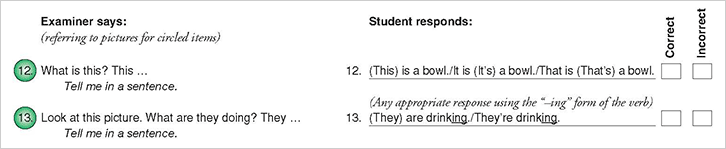
Look at item #12. Any of the three answers listed is correct. In some test items, the student’s ability to say a complete sentence or ask a question is being tested. In these cases, the student must answer with a complete sentence to receive credit. The expected response is always specified clearly in the “Student responds” column.
While administering the test, it is extremely important to remember that the student is taking a standardized test, and any help you give the student that is not included in the instructions or follow-up questions printed in the test booklet may invalidate the results. As educators, we naturally want students to give the correct answer. However, helping a student with an answer does not help the student at all. In fact, it could cause the student to be denied services that he or she truly needs. Make sure not to give clues for answers through nonverbal communication such as gestures, eye movements, or voice inflection.
Copyright © 2021 Ballard & Tighe, Publishers, a division of Educational Ideas, Inc.
These pages may be printed for use by course participants only.