Examiner’s Manual Resources that Support Score Interpretation and Use
The resources that support score interpretation and use are found in the Examiner’s Manual Appendixes. The following links explain what the appendixes contain and how they can be used. Click on the links to expand the view and see the explanation.
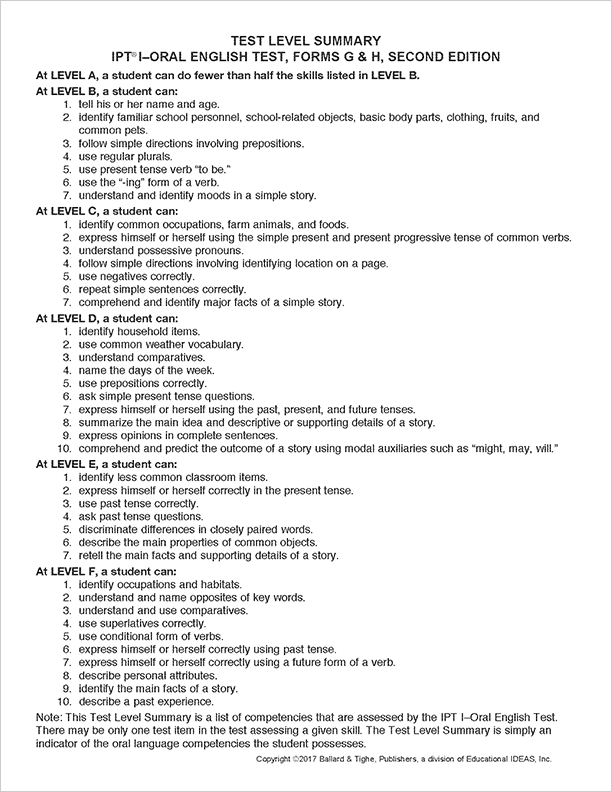
The Test Level Summary is a summary of the skills or competencies expected of the student on each test level. It is helpful in showing the basic oral language skills a student has learned as well as what the student still needs to learn. The Test Level Summary has many valuable uses, which include conferencing with parents (the Test Level Summary is provided in Spanish as well as English) and showing the teacher a student’s language skills when the teacher did not do the actual testing. However, as skills or competencies are only sampled by test items, the actual range of oral language competencies the student possesses is much larger and the level summary should be taken as a narrow indicator of the kinds of skills the student possesses. Click to see an example of a Level Summary.
This table groups test items within each test level by the main skill assessed in each item: vocabulary, grammar, comprehension, and verbal expression. The four main skills are in the rows and the test levels are in columns. The cells contain short descriptions of the skills assessed in each item. The numbers refer to the number of each question in the test booklet. This chart provides an x-ray of the test, and can be used to analyze if a student has particular areas of weakness, such as comprehension or grammar.
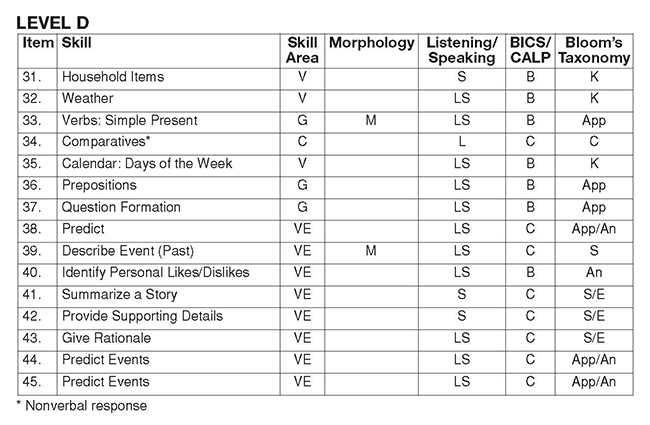
This chart in Appendix D of each of the IPT Oral Test Examiner’s Manuals illustrates the various ways that each test item has been analyzed. It includes information such as the skill area being assessed by the item and whether the item is testing a student’s BICS or CALP. The sample extract shows Level D (IPT I–Oral English, Forms G and H) of this chart. This chart can be used to derive possible instructional implications from the student’s test performance, identifying both strengths and potential weaknesses in the student’s skill profile.
Copyright © 2021 Ballard & Tighe, Publishers, a division of Educational Ideas, Inc.
These pages may be printed for use by course participants only.